Cart
0


Diamond earrings are one of those pieces you can wear every single day and still feel dressed up. But the moment you start shopping, the questions pile up. Studs or hoops? How much carat weight is enough? And why do two pairs that look almost identical have such different prices?
This diamond earrings buying guide answers all of those questions. You will see how diamond studs and diamond hoops compare, what actually affects the price, and how lab-grown diamonds fit into the picture. By the end, you will know what to look for and what to skip, so your pair is one you love for years, not just on the day you buy it.
Diamond earring styles compared
|
Style |
Look |
Best for |
Keep in mind |
|
Studs |
One stone sits on the lobe |
Everyday and work |
The backing matters most |
|
Hoops |
Diamonds set along the front of the hoop |
Casual to evening |
Check diameter and weight |
|
Drops |
A stone or cluster hangs below the lobe |
Events and gifts |
Moves more, snags more |
|
Huggies |
Small hoops that hug the lobe |
Stacking with studs |
The hinge needs care |
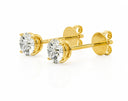
Here is how to choose. For everyday wear, diamond studs are the easiest pick, since they suit almost any outfit and rarely catch on hair or scarves. For evenings and events, drops add movement and length. And if you like a layered look, wear a stud in the first piercing and huggies in the second.
Hoop Earring Sizing & Comfort Guide
To choose the right diamond hoop, balance the diameter for your desired look with the pair's weight to ensure all-day comfort.
|
Hoop Diameter |
Visual Look |
Pair Weight Guide |
Comfort & Wearability |
|
10mm |
Hugs the lobe tightly; minimal space below the ear |
Under 2 grams |
Lightest feel; excellent for 24/7 wear and sleeping. |
|
12mm – 15mm |
Classic everyday look; small gap below the lobe |
2 – 4 grams |
Comfortable standard; easy to wear all day without pulling. |
|
20mm+ |
Bold statement style; highly visible from a distance |
5+ grams |
Heavier build; best for events as it can cause tugging over time. |
Example: If you want one pair for the office, dinners and weddings, a round solitaire stud pair of about 1/2 to 1 ct TCW covers all three.
Carat weight per pair vs per earring (what TCW means)

TCW stands for total carat weight. It is the combined weight of both diamonds. Here is how it works:
-
1/2 ct TCW: Two diamonds of 0.25 ct each
-
1 ct TCW: Two diamonds of 0.50 ct each
-
2 ct TCW: Two diamonds of 1.00 ct each
Some sellers list the weight of one earring only. Look for "tw" or "total weight" in the listing, and ask if it is not clear.
Example: The free gift at Rings of Australia for bigger orders is a lab diamond stud pair listed as 1/2 ct. tw. That means two 0.25 ct stones, not 0.50 ct each. Offers change, so check the current offers page.
Note: Weight is not the same as size. A well-cut stone looks larger from the front than a deep, badly cut stone of the same weight. So check the width in mm as well, and read our guide on carat weight if you want the full picture.
Diamond earring prices in Australia
These ranges come from the 14K white gold styles currently listed in our earrings collection, in AUD.
|
Style |
Examples listed |
Typical range |
|
Studs |
Classic round solitaire, hidden halo, princess halo, vintage |
About $700 to $1,050 |
|
Hoops |
Cannes, Florence bezel, Lisbon bezel |
About $920 to $1,430 |
|
Drops and hoop drops |
Primrose, Santorini, Zurich, Sydney, Amsterdam |
About $570 to $1,360* |
* Drops often carry smaller total carat weight, with length coming from metal rather than diamonds
The most expensive pair in the collection is about $2,780. What moves the price up or down:
-
Total carat weight: Price rises faster than weight as stones get bigger.
-
Metal: Platinum and 18K cost more than 14K or 9K.
-
Setting: Halos and hoops use more diamonds.
-
Origin: Lab-grown costs less than natural at the same size.
Rings of Australia lets you save up to 70% on diamond earrings compared with big-brand retail, since there is no shop rent or middlemen to pay for. Shipping is free and insured across Australia and New Zealand. Check out our diamond earrings collection now.
Diamond Earring Settings: bezel, martini and basket
A setting holds the stone in place, and it also shapes how your diamond earrings look and how secure they feel. The more metal around the diamond, the safer it is, and the less light gets in.
|
Setting |
Security |
Look |
Trade-off |
|
Bezel |
Highest |
|
Reduces diamond sparkle and makes the stone look slightly smaller by covering its outer edges. |
|
Martini |
Medium |
|
Can dig into or droop from thin or stretched earlobes due to its narrow, conical shape. |
|
Basket |
Medium |
|
Sits further off the ear, making the earrings more likely to snag on hair, clothes, or masks. |
Fewer prongs show more of the diamond, but they also leave less margin for error. If you lead an active life, a bezel or a six-prong basket is the safer choice. If sparkle is your priority, a martini or a four-prong basket lets in more light.
Earring backings and which actually stay on

The backing is the small part you never see until you lose an earring. Ranked from most to least secure:
-
Screw back: A threaded post that twists on. The best choice for heavier stones.
-
Locking back: Clicks into place and holds firmly. Easy to use every day.
-
Push back (friction or butterfly): Quick and common, but it can loosen over time. Fine for small, light studs.
A useful rule of thumb is to choose a screw back from about 1.50 ct tw upwards. Ask which backing is fitted before you order, and remove your diamond earrings before swimming or sleeping to protect both the setting and the post.
Example: A 2 ct TCW pair on basic push backs is a risk, because the weight slowly pulls the back loose. Choose screw backs or locking backs instead.
What carat size looks right
These sizes are approximate for well-cut round diamonds.
|
Pair size |
Each stone |
Width |
Look |
|
1/2 ct TCW |
0.25 ct |
About 4.1 mm |
Subtle, daily wear |
|
1 ct TCW |
0.50 ct |
About 5.1 mm |
Classic, clearly visible |
|
1.5 ct TCW |
0.75 ct |
About 5.8 mm |
Noticeable |
|
2 ct TCW |
1.00 ct |
About 6.5 mm |
Statement |
|
3 ct TCW |
1.50 ct |
About 7.4 mm |
Bold |
Diameters are approximate for well-cut round diamonds and vary slightly with cut. Smaller lobes and first pairs suit 1/2 ct TCW. A 1 ct TCW pair is a common sweet spot. Go to 2 ct TCW if you want the sparkle seen from across the room. Other shapes, such as oval or princess, measure differently.
Most first-time buyers of diamond studs choose between 0.50 and 1.00 ct tw, because the pair looks refined and wears all day comfortably.
Lab-grown diamond earrings: the value case
Lab-grown stones suit earrings well, since you are buying two of them. They are chemically and visually identical to mined diamonds, and only the origin is different. The same budget usually reaches a larger TCW, and the savings are doubled across two stones. The trade-off is that natural diamonds are rarer and usually hold resale value better, so they suit buyers who care about that most.
Both types are available in our lab-grown diamonds range and across every earring style. All natural and lab-grown diamonds from Rings of Australia are certified by independent grading authorities, the GIA or IGI.
Find Your Perfect Pair
Ready to pick a pair? Browse all diamond earrings or go straight to our diamond stud earrings. Custom pairs take about 3 to 6 weeks, and every order ships free and insured across Australia and New Zealand.
Frequently asked questions
What does TCW mean?
TCW is the total carat weight, the combined weight of both diamonds. A 1 ct TCW pair is two 0.50 ct stones, so check whether a listing shows the total or one earring.
What carat for studs?
Most people choose between 1/2 ct and 1 ct TCW. Go smaller for a subtle everyday look, and 1 ct TCW or more for stronger sparkle.
Are lab diamond earrings worth it?
For most buyers, yes. Lab-grown diamonds look and test like mined ones and cost less, so the same budget buys a larger pair.
Which backing is safest for diamond studs?
Screw backs and locking backs hold best, especially with larger stones. Push-backs suit small, light studs but can loosen with time.
Are your diamonds certified?
Yes, all natural and lab-grown diamonds from Rings of Australia are certified by independent grading authorities, the GIA or IGI.
Can I return diamond earrings if they don't suit me?
No, you cannot return diamond earrings just because they don’t suit you. Returns are allowed only if the items arrive damaged.
How long does a custom pair take?
Custom diamond earrings usually take about 3 to 6 weeks. You see 3D renders before production starts.
Do you ship diamond earrings for free?
Yes. Every order ships free and insured across Australia and New Zealand, and every pair has a lifetime craftsmanship warranty.